
Across both developing nations and rural corridors within high-income countries, millions of families face a growing healthcare crisis: the expansion of maternity care deserts. A maternity care desert is defined as a county or geographic area lacking access to hospitals offering obstetric care, birth centers, or licensed OB-GYN providers. When access to basic reproductive healthcare is stripped away, maternal and infant mortality rates inevitably rise.
Eliminating these gaps requires a fundamental shift in healthcare delivery models. Community-based midwifery offers a proven, cost-effective, and deeply compassionate solution capable of restoring safety and dignity to underserved regions.
1. Understanding the Scope of Maternity Care Deserts
The loss of rural hospital labor units and the centralization of specialized medical services have left vast geographic regions without immediate access to maternal care. Families living in these areas often must travel upwards of an hour—sometimes across difficult terrain—just to receive routine prenatal checkups or access emergency care during labor.
This lack of geographical proximity creates severe barriers:
- Delayed Prenatal Care: Long transit times and lack of flexible scheduling cause many mothers to miss crucial early health screenings.
- Higher Emergency Rates: Without continuous monitoring, preventable conditions like preeclampsia, gestational diabetes, and fetal growth restriction often go undetected until they become life-threatening emergencies.
- Financial & Logistics Stress: The costs of travel, missing work, and arranging childcare for existing children place an unsustainable burden on low-income families.
2. The Midwifery Model: High Touch, Low Intervention

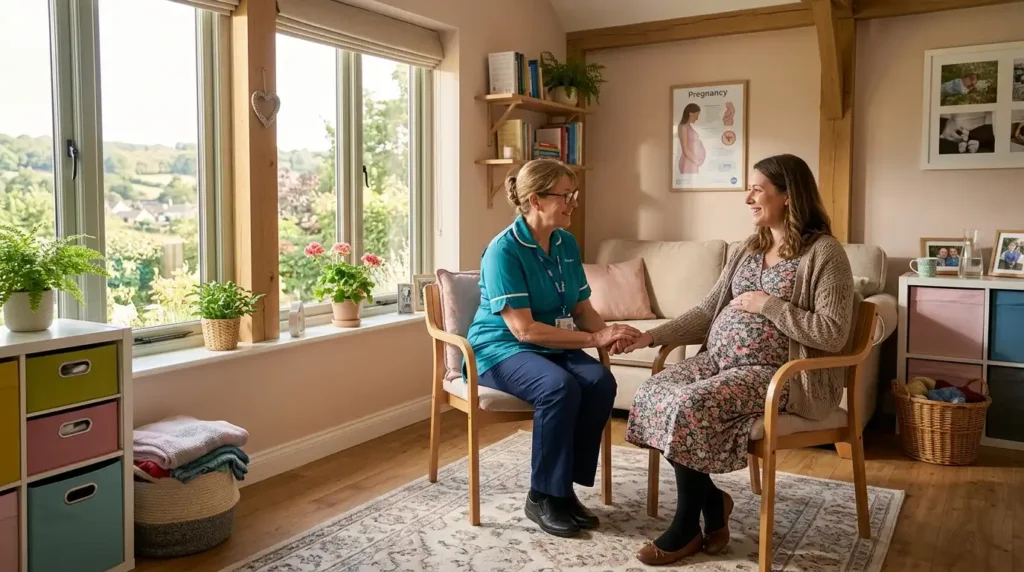
Community-based midwives—including Certified Nurse-Midwives (CNMs), Certified Professional Midwives (CPMs), and licensed traditional midwives—are uniquely equipped to address this crisis. Unlike centralized hospital systems designed primarily around acute medical intervention, the midwifery model prioritizes continuous, preventative, and client-centered care.
Preventative Screenings & Holistic Well-being
By establishing localized clinics, birth centers, or mobile home-visit routines, midwives bring essential prenatal monitoring directly into communities. Midwives monitor vital signs, assess fetal growth, order necessary laboratory work, and provide tailored nutritional and lifestyle guidance. This proactive approach prevents complications before they arise.
Reducing Unnecessary Medical Interventions
Research consistently demonstrates that low-risk pregnancies managed by trained midwives experience lower rates of unnecessary cesarean sections, routine episiotomies, and labor inductions. By supporting natural physiological labor, midwives optimize health outcomes while reducing the financial burden on safety-net health systems.
3. Bridging Cultural Gaps and Building Community Trust
The impact of community-based midwifery extends far beyond physical health clinical metrics; it is rooted in trust, shared culture, and mutual respect. In many marginalized or indigenous communities, historical medical trauma and systemic discrimination create deep hesitancy toward institutional hospital settings.
Community midwives often live within the neighborhoods they serve. They understand local customs, language nuances, and social dynamics. By providing culturally congruent care, midwives foster psychological safety, empowering pregnant individuals to actively participate in decisions regarding their body, labor choices, and family planning.
4. Integrating Midwifery into Primary Healthcare Networks
To fully eliminate maternity care deserts, community midwifery cannot exist in isolation. Sustainable healthcare relies on seamless integration between community-based birth workers and tertiary regional medical centers.
Collaborative Transfer Protocols
When high-risk conditions develop—such as severe hypertension, hemorrhage, or fetal distress—established, respectful transfer protocols ensure that families move quickly from community care to specialized hospital environments without bureaucratic delays or punitive friction.
Expanding Scope of Practice & Policy Reform
Legislative backing is essential to scaling midwifery care in underserved areas. Policy makers must prioritize autonomous practice laws, expand Medicaid reimbursement parity for community birth settings, and invest in midwifery educational pipelines—particularly for students from rural and underrepresented backgrounds.
5. The Economic and Social Return on Investment

Investing in community-based midwifery yields extraordinary returns for public health systems. By reducing premature births, lowering NICU admission rates, and preventing severe maternal morbidity, integrated midwifery care saves millions in public healthcare expenditures while producing healthier, more resilient communities.
Every family, regardless of zip code or socio-economic standing, deserves access to safe, dignified, and accessible maternal care. Expanding community midwifery is not merely a healthcare convenience—it is a vital human rights priority.
Summary
Community-based midwifery represents a transformative bridge over the growing void of maternity care deserts. Through compassionate, localized, and preventative care, midwives safeguard the lives of mothers and babies, building a future where quality maternal healthcare is accessible to all.